If you woke up this morning wondering who Bad Bunny is and why your entire social media feed is suddenly covered in posts about him, you’re not alone. Let me explain what happened Sunday night and why it matters, not just for music fans, but for anyone paying attention to culture and power.
What Happened at the Super Bowl
The Super Bowl is the biggest television event in America. Over 100 million people watch it every year. The halftime show is one of the most coveted performance slots in the world. Past performers include Michael Jackson, Beyoncé, Prince, and other global megastars who typically use those 12-15 minutes to deliver massive spectacle and play their biggest hits.
This year, a Puerto Rican artist named Bad Bunny (real name: Benito Antonio Martínez Ocasio) took that stage and did something completely unprecedented. He performed entirely in Spanish. He centred the entire show around Puerto Rican culture, history, and political reality. He didn’t make a single concession to make it more “accessible” or palatable for the massive American audience.
And your feed exploded because what he did was both a celebration and a protest, a love letter and an accusation, all wrapped in thirteen minutes that forced over 100 million people to actually see Puerto Rico – not as a vacation destination, but as a living culture with a painful colonial history.
Who Is Bad Bunny?
Bad Bunny is the biggest Latin artist in the world right now. He’s a reggaeton and Latin trap artist from Puerto Rico who’s been breaking records for years. But what makes him different isn’t just his music. It’s what he does with his platform.
He’s openly feminist in a genre known for misogyny. He’s worn dresses and skirts, challenging rigid ideas about masculinity. He’s kissed men on stage. He’s used his music to talk about gentrification, colonialism, and political corruption. And crucially, he’s never compromised his language or his cultural specificity to “break into” the American market.
But to understand why Sunday night was so significant, you need to understand what led up to it.
The Year That Built to This Moment
In January 2025, Bad Bunny released an album called “Debí Tirar Más Fotos”, in English “I Should Have Taken More Photos.” The title alone tells you what it’s about: nostalgia, loss, watching your home change so fast you can’t hold onto it. The entire album is in Spanish and deeply rooted in the Puerto Rican experience. Even musically, it is rooted in Puerto Rican styles – primarily reggaeton and Latin trap, and heavily infused with traditional Puerto Rican styles like plena, bomba, salsa, and música jíbara. He is singing about gentrification, displacement, the ways the island is being bought up and transformed by wealthy outsiders.
He could have made it more “commercial.” He could have included English songs to reach a wider audience. Instead, he said in interviews that he made it for Puerto Ricans first, knowing it might not translate everywhere else. The album debuted at #1 anyway. Benito even got the Grammy award for it.
Then, from July through September 2025, he held a residency in Puerto Rico called “No Me Quiero Ir De Aquí”, or “I Don’t Want to Leave Here” in English. Not the mainland USA, where he could have sold more tickets and made more money. In Puerto Rico. During hurricane season, the most vulnerable time for the island. He made the initial shows available only to Puerto Rican residents, literally prioritising his community over maximum profit.
Each night, he invited different Puerto Rican artists to perform with him. The final show, he brought out Marc Anthony, another Puerto Rican icon, who sang “Presiosa” – a song about Puerto Rico’s beauty and resilience that Marc Anthony hadn’t performed in over 20 years. It was emotional, defiant, and deeply rooted in place.
This wasn’t just entertainment. It was cultural preservation as resistance.
What You Need to Know About Puerto Rico
Here’s what most people don’t understand: Puerto Rico is a colony. The United States doesn’t call it that. Officially, it’s an “unincorporated territory”. Functionally, it’s a colony.
Spain ceded Puerto Rico to the US in 1898. Since then, people born there are US citizens, but they can’t vote for president. They have no voting representation in Congress. They’re subject to US federal law but have almost no say in making those laws.
For decades, the US military used part of the Puerto Rican archipelago for bombing practice, contaminating the land. The island’s economy is structured to benefit outsiders. Wealthy Americans move there for tax breaks, driving up prices so locals can’t afford their own neighbourhoods. When Hurricane Maria devastated the island in 2017, killing an estimated +3,000 people, the official government death toll was recorded as 64. The electrical grid still fails regularly, leaving people without power for days or weeks.
This is the context Bad Bunny has been speaking to all year. The album talks about it. The residency was held on the island as an act of staying, of refusing to leave. And the Super Bowl performance made it impossible to ignore.
What the Performance Actually Showed
Every second of this performance was filled with symbolism and meaning, quite literally. This is the short version of it:
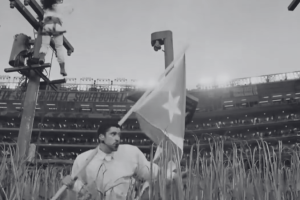
The show opened in sugarcane fields with workers harvesting. Sugarcane is how American corporations extracted wealth from Puerto Rico after taking control in 1898, displacing farmers, depleting the land, and building an economy designed for extraction.
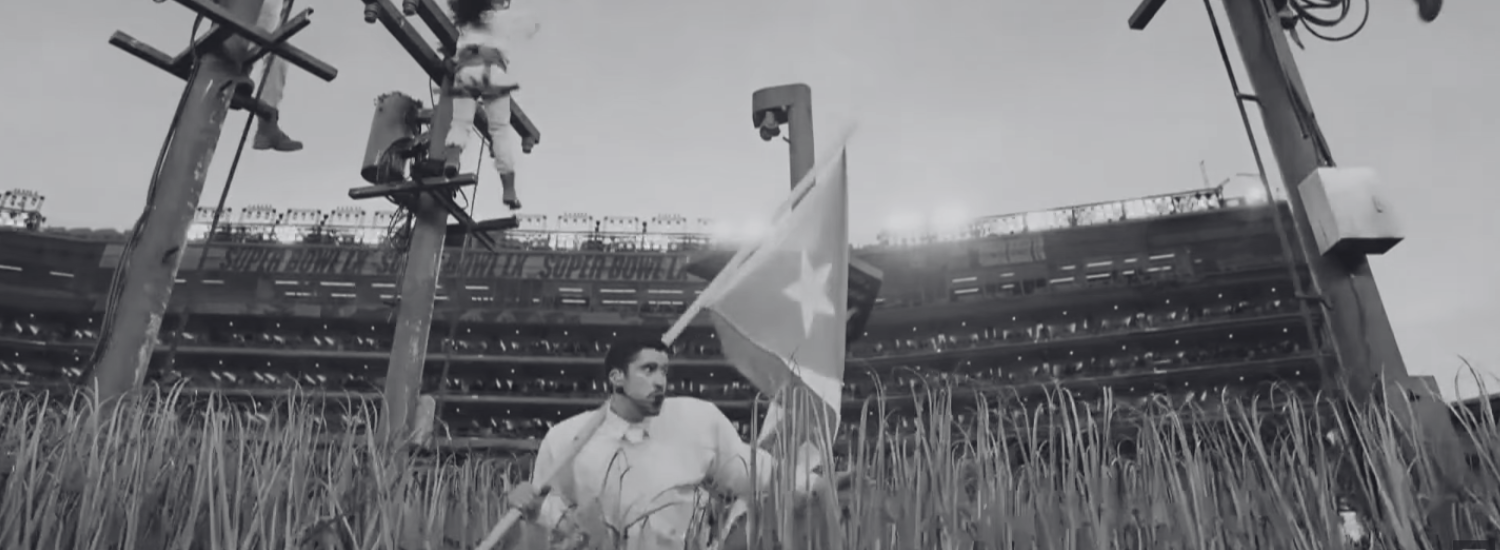
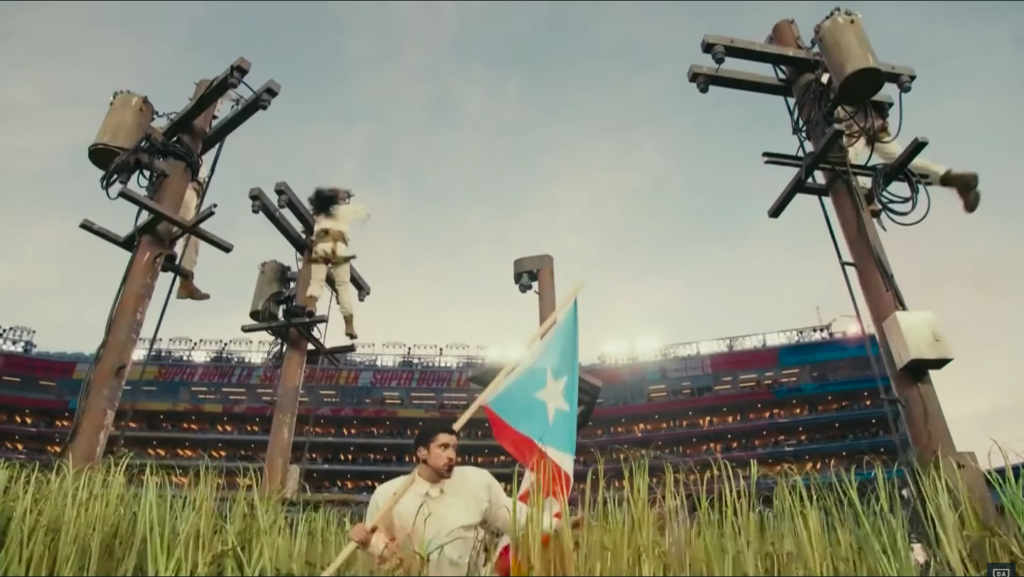
Throughout the performance, Bad Bunny showed scenes of everyday Puerto Rican life: people playing dominoes, piragua stands selling shaved ice, house parties, barbershops, nail salons, life of Puerto Ricans in NY, tribute to old-school reggaeton artists. But he also showed women dancing on electrical poles, which was a direct reference to the island’s ongoing power crisis. He sang “El Apagón” (The Blackout), his song criticising both the Puerto Rican and US governments’ neglect of the island.
He carried the light blue Puerto Rican flag – not the standard flag, but the original colours that were banned by the US government from 1948 to 1957 because they represented the independence movement. Carrying that flag at the Super Bowl, in front of over 100 million Americans, was a deliberate political statement.
Even Lady Gaga, the guest artist, came dressed in a light blue dress with a Puerto Rican flower on it, and sang the salsa version of her song. This was a sign of respect for the culture. She showed people to appreciate, not to appropriate. His other guest, Ricky Martin, sang “Lo Que Le Pasó a Hawaii“ – one of the most potent songs from the album that speaks of the loss of Puerto Rican identity and culture and a “downfall“ similar to Hawaii.
He ended by saying “God bless America” and then listed every country in the Americas: Chile, Argentina, Uruguay, Paraguay, Bolivia, Peru, Ecuador, Brazil, Colombia, Venezuela, Guyana, Panama, Costa Rica, Nicaragua, Honduras, El Salvador, Guatemala, Mexico, Cuba, República Dominicana, Jamaica, Antillas, United States, Canada, and his homeland, Puerto Rico. A reminder that “America” isn’t just one country. It’s a hemisphere. And he closed with two words: “Seguimos aquí” – we are still here.
Above all, he shared the message of joy, love and unity throughout the entire performance. From the real wedding that took place on stage, to the message displayed on the screen that read “The only thing more powerful than hate is love,“ and the ball with print that said “Together, we are America“.
Why This Matters Beyond Music
This moment cannot be separated from the climate in which it happened.
We are living through a period of intensified division. Anti-immigrant rhetoric is no longer coded. Latino communities in the USA are being targeted in policy and in practice. ICE raids are used as political theatre, and they terrorise the immigrant communities across the country. Spanish is still treated by some as a threat rather than a language. Indigenous histories continue to be minimised, distorted, or erased altogether.
At the same time, economic inequality has widened to historic levels. Wealth concentrates upward while working-class communities (disproportionately immigrant and Latino) absorb the pressure. And instead of confronting that imbalance, public discourse is often redirected toward culture wars: who belongs, who speaks what language, who is “real” American.
When the Super Bowl announcement came out, there was massive backlash. Death threats. Division. A right-wing organisation even created a counter-performance just to spite him. The internet was full of people saying he didn’t belong there, that he should sing in English, that he should “respect” the American audience.
Bad Bunny refused that premise.
There was no apology. No linguistic compromise. No attempt to dilute identity for broader approval.
In this context, that choice carries weight.
He chose to act from the place of love – for his people and his country, but also for all the people in America and beyond.
He showed us what resistance through joy looks like.
Going Back to Your Question
This is why your feed exploded. Not because Bad Bunny is just another celebrity. But because in a world full of division and violence and people being told to assimilate or disappear, he spent an entire year doing the opposite.
He made an album for his people first. He held shows on his island when it would have been more profitable to go elsewhere. He used the biggest stage in America to tell the truth about what the US has done and is still doing to Puerto Rico. He celebrated his culture while simultaneously protesting its erasure.
And he did all of it without asking permission, without compromising, without translating himself for anyone’s comfort.
In a chaotic time when everything feels like it’s being torn apart, when hate and division dominate the conversation, Bad Bunny showed up with love and unity while celebrating diversity. He showed up with truth in a time desperate for it.
That’s why your feed exploded. Because people recognise when something real cuts through the noise. Because representation matters, not just seeing yourself reflected, but seeing someone refuse to diminish themselves for acceptance. Because what he did Sunday night wasn’t just entertainment. It was a demonstration of what’s possible when you stop calculating and just commit fully to being yourself.
And whether you knew who Bad Bunny was before Sunday or not, you witnessed something historic. You witnessed someone using the biggest platform in America to say: we are still here, we’re not going anywhere, and we’re done asking for your approval.
That’s why everyone is talking about it. That’s why it matters. And that’s why, even if you’ve never listened to reggaeton in your life, what happened Sunday night was worth paying attention to.
Read Next
- All Posts
- Beyond Borders

A short reflection on the stagnation and systemic challenges plaguing Montenegro and the wider Global South.

From the shadows of a tragic past to the vibrant present, Rwanda's remarkable journey inspires hope and resilience.

Learn how rare minerals from developing nations fuel the global arms race instead of vital progress - and why we...